Customer Success vs Customer Service: Key Differences and Email Metrics
Customer success and customer service aren't the same team. Here's how they differ, which email metrics each should track, and what the data looks like in practice.
Quick Answer
Is customer success the same as customer service?
- No. Customer service is reactive — it responds to problems as they arise. Customer success is proactive — it anticipates problems before they happen.
- Different goals: customer service measures resolution speed and satisfaction. Customer success measures retention, expansion, and long-term account health.
- Different email patterns: support teams receive inbound requests and track FRT and FCR. CS teams initiate outbound check-ins and track response time by account and email engagement trends.
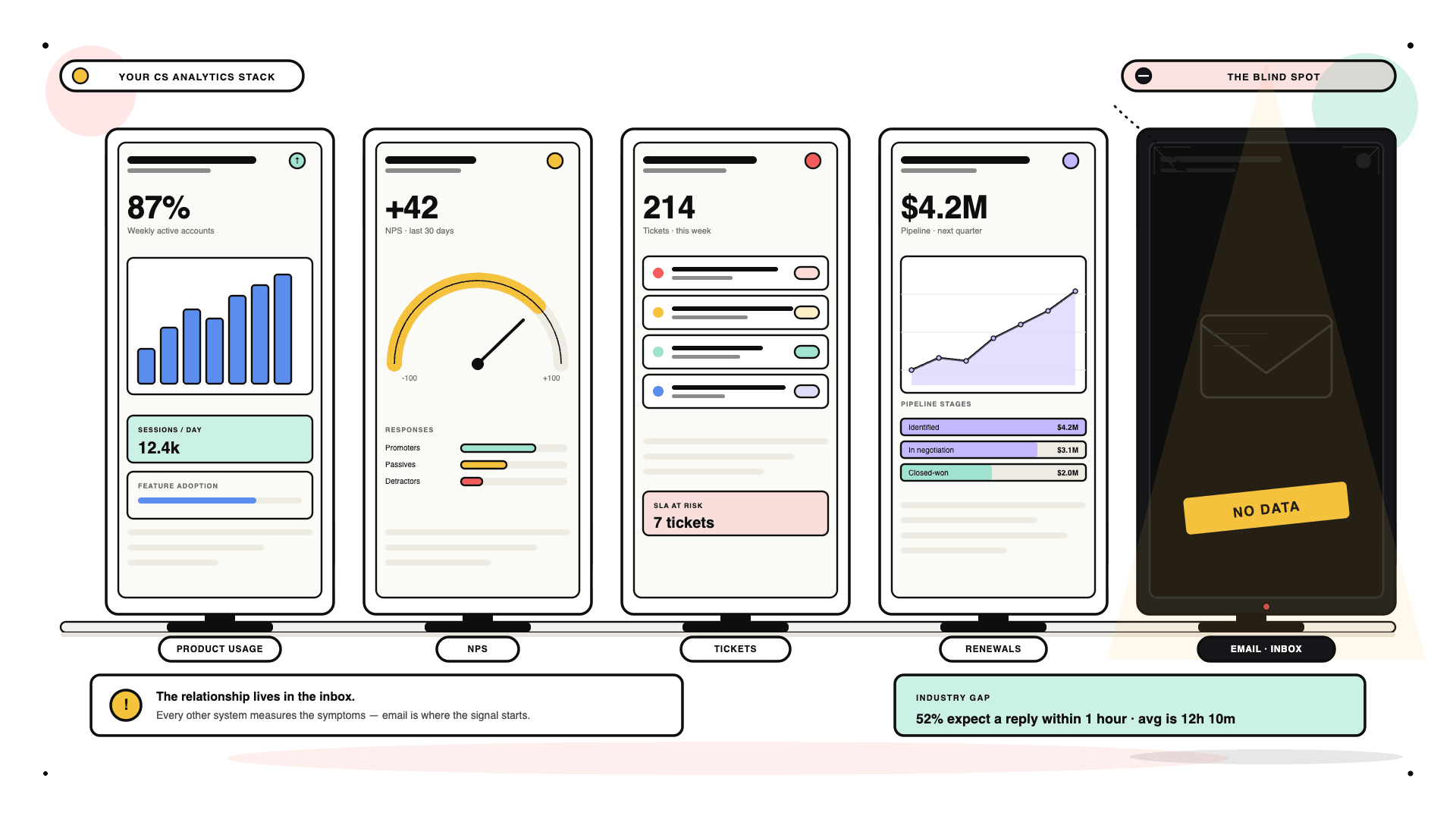
- Both need email data: support needs it to manage SLAs. CS needs it to detect churn signals 60–90 days before they become visible. See how email analytics serves both teams →
Customer success and customer service are two of the most frequently confused functions in B2B SaaS — and the confusion has real consequences. Teams that treat them as the same thing end up with support agents doing CSM work reactively, or CSMs drowning in ticket queues instead of managing account health proactively.
The distinction matters not just organizationally, but operationally: the two teams track different metrics, send and receive email differently, and need different data to do their jobs well. This guide covers the key differences, the right metrics for each team, and how email data connects both functions to retention outcomes. For a full breakdown of how email analytics supports CS teams specifically, see our email analytics for customer success teams guide.
What is customer service?
Customer service is the reactive function that handles customer problems as they arise. When a customer encounters a bug, a billing issue, or a question they can't answer themselves, customer service is the team they contact. The primary objective is speed and resolution — respond quickly, solve the problem, close the ticket.
Customer service teams are measured on how efficiently they handle inbound volume. The metrics that matter are First Response Time, First Contact Resolution Rate, Average Resolution Time, and CSAT. The relationship with the customer is transactional — it begins when the customer reaches out and ends when the issue is resolved.
In most B2B SaaS companies, customer service handles:
- Technical support and bug reports
- Billing and account questions
- Onboarding troubleshooting
- Feature questions and how-to requests
- Complaint handling and escalations
What is customer success?
Customer success is the proactive function that manages the long-term health of customer accounts. Rather than waiting for problems to arise, CS teams anticipate them — monitoring usage patterns, checking in regularly, and intervening before dissatisfaction becomes a cancellation request.
The primary objective of customer success is retention and expansion. CS teams are measured on renewal rates, net revenue retention, account health scores, and churn prevention. The relationship with the customer is ongoing — it spans the entire lifecycle from onboarding to renewal and beyond.
In most B2B SaaS companies, customer success handles:
- Onboarding and time-to-value acceleration
- Regular check-ins and business reviews
- Renewal conversations and contract negotiations
- Upsell and expansion opportunities
- Churn risk identification and save plays
Customer success vs customer service: 6 key differences
| Customer service | Customer success | |
|---|---|---|
| Approach | Reactive | Proactive |
| Timeline | Short-term — issue to resolution | Long-term — full customer lifecycle |
| Primary goal | Resolve problems fast | Prevent problems, drive retention |
| Triggered by | Customer inbound request | CS team outbound initiative |
| Success metric | CSAT, FRT, FCR, resolution time | NRR, renewal rate, account health |
| Revenue role | Cost center — keeps customers from leaving | Growth engine — drives renewals and expansion |
| Relationship type | Transactional | Ongoing, strategic partnership |
1. Reactive vs proactive
This is the most fundamental difference. Customer service teams wait for customers to reach out. Customer success teams reach out first — monitoring account health, usage data, and email engagement patterns to identify accounts that need attention before they say anything.
2. Short-term vs long-term focus
A customer service interaction has a beginning and an end: the customer submits a ticket, the agent resolves it. A customer success relationship spans months or years. A CSM managing 50 accounts is simultaneously tracking where each account is in their lifecycle, what their renewal date is, and whether their email engagement has changed over the last 30 days.
3. Different success metrics
Customer service is measured on efficiency and satisfaction — how fast, how well. Customer success is measured on outcomes — did the customer renew, expand, and achieve their goals? These different objectives require different metrics, different tools, and different email behaviors.
4. Different email patterns
Support teams receive inbound email and respond. CS teams initiate outbound email and track whether customers respond. This distinction matters for how you measure each team — a support team's FRT is a measure of responsiveness, while a CS team's outbound email frequency and client response rate are measures of relationship health.
5. Cost center vs growth engine
Customer service is typically a cost center — the business invests in it to prevent customer loss and maintain satisfaction. Customer success is increasingly seen as a growth engine — CS teams directly drive net revenue retention through renewals, upsells, and expansion. Forrester found that a well-designed customer success initiative can yield 91% ROI within three years.
6. Who they serve
Customer service teams handle the full customer base — any customer with any issue at any point in their lifecycle. Customer success teams typically focus on higher-value accounts where the investment in proactive management pays off in retention and expansion revenue.
Customer success vs customer experience
Customer experience (CX) is a broader function than either customer service or customer success. Where CS and support focus on specific interactions or relationships, CX encompasses the entire end-to-end journey a customer has with a brand — from first marketing touchpoint to renewal and advocacy.
| Customer experience | Customer success | Customer service | |
|---|---|---|---|
| Scope | Full customer journey | Post-sale lifecycle | Issue-specific interaction |
| Owner | Cross-functional | CSM team | Support agents |
| Metrics | NPS, CES, brand perception | NRR, churn rate, health score | CSAT, FRT, FCR |
| Email role | All touchpoints combined | Outbound check-ins, engagement tracking | Inbound support, response time |
In practice, customer success sits at the intersection of CX and revenue. CS teams are the primary owners of the post-sale customer experience for B2B accounts, making their work both a CX function and a direct revenue driver.
The email metrics that distinguish each team
This is where the operational difference becomes concrete — and where most teams leave visibility on the table. Customer service and customer success teams interact with customers via email very differently, and the metrics that matter are completely different as a result.
Customer service email metrics
Support teams receive inbound email and are measured on how fast and well they respond. The metrics that matter:
- First Response Time (FRT) — how long it takes to send the first reply. For B2B enterprise accounts, under 2 hours. For mid-market, under 4 hours. See our SLA response time guide for benchmarks by industry.
- First Contact Resolution Rate (FCR) — percentage of issues resolved in the first exchange. Benchmark: 70% average, 85% for top teams.
- Average Resolution Time — total time from first email to resolution. Under 24 hours for standard B2B issues.
- SLA compliance rate by tier — not just as a team average, but broken down by client tier. A 90% overall rate can hide 40% compliance for enterprise accounts.
- Unreplied email rate — percentage of emails that received no reply within your SLA window. For high-value accounts, an unreplied email is a direct churn risk.
- Workload distribution — volume per agent. Imbalances drive slower response times for the clients assigned to overloaded agents.
Customer success email metrics
CS teams initiate outbound email and are measured on relationship health, not resolution speed. The metrics that matter — and that most CS tools don't surface from email data:
- Response time by client account — not team average, but per account. If your enterprise clients are waiting 6 hours on average for replies from your CS team, that's a relationship problem regardless of your overall team average.
- Email engagement trends by account — the most powerful early churn signal available in email data. A client who used to respond within hours and now takes days, or whose email frequency has dropped 40% over 90 days, is signaling disengagement long before they say anything. See our 90-day churn warning guide for a full breakdown.
- Check-in frequency — how often each CSM is proactively reaching out to their accounts. Accounts that go 30+ days without a CSM-initiated email are at elevated churn risk.
- Thread response rate on outbound — what percentage of CSM check-in emails receive a reply? A declining response rate on outbound emails is an early indicator of client disengagement.
- Escalation signals in email content — increasing urgency, repeated follow-ups, references to unresolved issues. These appear in email language before a formal complaint or cancellation request.
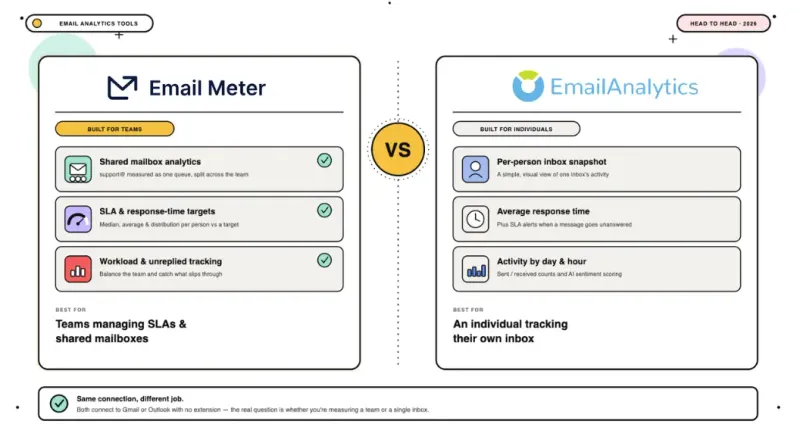
Email Meter surfaces all of these metrics automatically from Gmail and Microsoft 365 — for both support teams (inbound metrics) and CS teams (account-level engagement tracking). For a complete guide to email analytics for CS teams, see our email analytics for customer success teams guide.
How email patterns differ between CS and support teams in practice
The difference in email behavior between the two teams is stark — and it shapes what data you need to collect and how you need to interpret it.
A support team's inbox is reactive by design. Emails arrive from customers, agents respond, threads close. The key risk is speed — emails that wait too long before a first reply, or threads that stall mid-resolution. The data you need is inbound volume, FRT per agent, and SLA compliance by tier.
A CS team's inbox is proactive by design. CSMs initiate contact, clients respond (or don't). The key risk is silence — accounts that stop engaging, CSMs who aren't reaching out often enough, and relationship patterns that indicate a client is pulling away. The data you need is outbound frequency per CSM, response rate by account, and engagement trend over 30/60/90 days.
Most teams use the same reporting tool for both functions — and end up with metrics that don't fit either team's actual workflow. Email Meter tracks both patterns separately: inbound support metrics for support teams, and account-level engagement trends for CS teams, from the same Gmail or Microsoft 365 connection.
Do you need both teams?
For most B2B SaaS companies with recurring revenue, yes. Here's a simple framework:
| Company stage | What you need |
|---|---|
| Early stage, <50 customers | One team wearing both hats — focus on support first |
| Growth stage, 50–200 customers | Dedicated support + 1-2 CSMs for top accounts |
| Scale stage, 200+ customers | Separate support and CS teams with distinct metrics |
| Enterprise, complex accounts | Support + CS + dedicated account management per tier |
The key signal that it's time to separate the functions: when your support agents are spending significant time on proactive account management, or when your CSMs are getting pulled into ticket resolution and losing time for strategic work. At that point, the two functions have grown large enough to need dedicated ownership — and dedicated metrics.
Frequently asked questions
Is customer success the same as customer service?
No. Customer service is reactive — it handles inbound requests from customers who have a problem. Customer success is proactive — it manages long-term account health, anticipates problems before they arise, and drives retention and expansion. The teams use different metrics, operate on different timelines, and interact with customers via email in fundamentally different ways.
What is the difference between customer success and customer support?
Customer support is a subset of customer service focused on technical issues and product-related questions. Customer success is a strategic function focused on helping customers achieve their goals over the long term. Support is reactive and measured on resolution speed. Customer success is proactive and measured on renewal rates, net revenue retention, and account health scores.
What is the difference between customer experience and customer success?
Customer experience (CX) is the broadest of the three — it encompasses every touchpoint a customer has with a brand from first awareness to renewal. Customer success is a specific post-sale function within the broader CX ecosystem. CX is typically a cross-functional strategy; customer success is a dedicated team with its own metrics, tools, and account ownership.
What metrics should customer service teams track?
The core metrics for email-based customer service teams are First Response Time (target: under 4 hours for mid-market B2B, under 2 hours for enterprise), First Contact Resolution Rate (benchmark: 70–85%), SLA compliance rate by client tier, unreplied email rate, and workload distribution per agent. For a complete breakdown with formulas and benchmarks, see our customer service performance metrics guide.
What metrics should customer success teams track?
CS teams should track response time by client account (not team average), email engagement trends by account over 30/60/90 days, outbound check-in frequency per CSM, thread response rate on outbound emails, and escalation signals in email content. These are the metrics that predict churn 60–90 days before a cancellation request — and they live in email data, not in ticketing systems.
How do customer success and customer service impact retention?
Both directly impact retention but through different mechanisms. Customer service impacts retention by resolving issues fast enough that customers don't lose confidence in the product. Customer success impacts retention by ensuring customers are achieving their goals and have a clear reason to renew. Research consistently shows that slow email response times predict churn — making email performance data a leading retention indicator for both teams. For the full picture, see our 90-day churn warning guide.